- VI
- EN
Inverting the Triangle (Đảo tam giác ràng buộc)
TL;DR
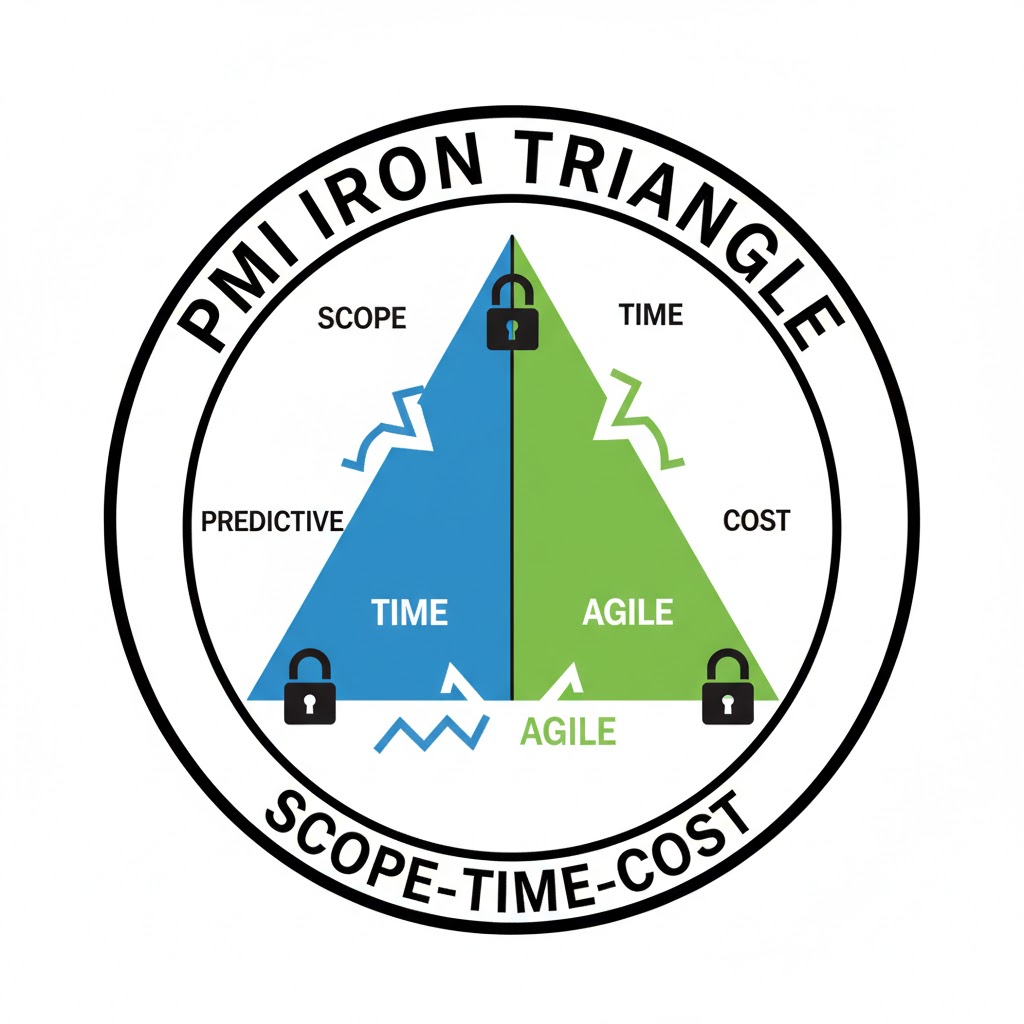
- Predictive/Traditional (plan-driven): cố định phạm vi (scope baseline) → tiến độ (schedule) và chi phí (cost) có thể biến thiên để hoàn thành toàn bộ phạm vi đã cam kết.
- Agile/Adaptive: cố định thời gian & chi phí bằng timebox và ngân sách cố định → phạm vi sẽ thay đổi/được tinh chỉnh theo giá trị qua mỗi increment.
- Mục tiêu học: hiểu rõ tam giác ràng buộc (Iron Triangle / Triple Constraint) của PMI và cách “đảo tam giác” trong Agile giúp tối ưu time‑to‑value.
Khái niệm: Tam giác ràng buộc của PMI
Tam giác ràng buộc (còn gọi Iron Triangle/Triple Constraint) gồm Scope – Schedule – Cost. Trong môi trường Predictive, thường cố định Scope, còn Schedule/Cost phải điều chỉnh để đạt Scope. Trong Agile, tổ chức khóa lịch & ngân sách (timebox/budget), còn Scope được ưu tiên & tinh chỉnh dần thông qua product backlog và incremental delivery.
Ghi chú nhanh về ưu tiên theo giá trị:
CoD (Cost of Delay) = chi phí cơ hội do trì hoãn; WSJF (Weighted Shortest Job First) ≈ CoD / Size → ưu tiên mục giá trị cao & nhỏ trước.
Ví dụ chớp nhoáng: A(CoD=200, Size=5) → WSJF=40; B(CoD=150, Size=3) → WSJF=50 ⇒ ưu tiên B trước A.
Khi “đảo tam giác”, Scope là phạm vi chức năng giao; chất lượng vẫn phải đạt Definition of Done (DoD).
Ta cắt/bỏ hạng mục giá trị thấp, không hạ tiêu chuẩn chất lượng của hạng mục còn lại.
Liên quan: Agile vs Traditional • Iterative vs Incremental • Value-Driven Delivery
Hình dung nhanh
Predictive (cố định Scope):    ▲ Scope cố định
                               ◣ Schedule biến thiên
                               ◥ Cost biến thiên

Agile (đảo tam giác):          ▼ Scope biến thiên theo giá trị
                               ◢ Schedule cố định (timebox)
                               ◣ Cost cố định (budget)
Giữ đúng thuật ngữ PMI: sử dụng Scope/Schedule/Cost, baseline, timeboxing, progressive elaboration, product backlog, increment.
Từ video sang khái niệm PMI (biên tập nội dung gốc)
- Predictive: mục tiêu là không đổi phạm vi. Thu thập đầy đủ yêu cầu, lập kế hoạch upfront với budget & schedule, sau đó thực thi để xây đủ scope. Thực tế, Schedule/Cost dễ trượt so với kế hoạch ban đầu.
- Agile: chào đón thay đổi; Scope sẽ được xác định, tinh chỉnh, tái định nghĩa liên tục (define → refine → redefine) theo giá trị và phản hồi thực tế. Time và Cost được giữ cố định (timebox & fixed budget) → nhóm tối đa hóa giá trị trong ràng buộc đó.
- Câu hỏi phổ biến: “Nếu cứ thêm bớt phạm vi, bao giờ dự án kết thúc?”
Câu trả lời theo sách: khi hết thời gian & ngân sách (đã ấn định). Ta giao phần giá trị cao trước, phần giá trị thấp về sau có thể không cần làm.
Thực tế: với sản phẩm phần mềm, vòng đời DevOps khiến công việc liên tục (không nằm trong phạm vi PMI‑ACP thi cử).Lưu ý thi cử: Khi làm bài, ưu tiên kết thúc theo time/budget; DevOps chỉ là bối cảnh tham khảo.
Bảng đối chiếu: Predictive vs Agile theo tam giác PMI
| Khía cạnh (PMI) | Predictive (plan-driven) | Agile/Adaptive |
|---|---|---|
| Scope | Cố định (scope baseline) | Biến thiên (ưu tiên theo giá trị qua product backlog) |
| Schedule | Biến thiên nếu cần để đạt đủ scope | Cố định (timeboxed iterations/releases) |
| Cost | Biến thiên nếu cần để đạt đủ scope | Cố định (ngân sách cố định / funding runway) |
| Cách kiểm soát | Change control bảo vệ baseline | Backlog ordering, progressive elaboration, DoD, frequent demos |
| Hệ quả | Có thể giao muộn nhưng đủ phạm vi | Giao sớm, phù hợp hơn, loại bỏ hạng mục giá trị thấp |
Khi nào chọn cách nào?
- Chọn Predictive khi phạm vi ổn định, yêu cầu khó thay đổi, hoặc có ràng buộc tuân thủ đòi hỏi giao đủ bộ scope đã duyệt.
- Chọn Agile khi biến động cao, cần time‑to‑value sớm, muốn tối đa hóa giá trị trong time/budget cố định.
Gợi ý thi PMI‑ACP: câu hỏi tối ưu value/time‑to‑value → timeboxing + ưu tiên backlog theo giá trị (CoD/WSJF).
“Dự án Agile kết thúc khi nào?”
- Theo sách: khi hết thời gian & ngân sách đã ấn định; giá trị cao nhất được giao ở đầu.
- Thực tế sản phẩm: nhiều tổ chức vận hành theo DevOps (continuous delivery & operations), nên không có điểm kết thúc cứng như dự án truyền thống. (Nội dung tham khảo, không bắt buộc cho kỳ thi.)
Mini-quiz (in-line)
- Bạn cần giao đủ phạm vi đã duyệt, có thể thêm thời gian/chi phí → Predictive (cố định Scope).
- Time & Budget đã chốt, muốn tối đa hóa giá trị → Agile (Scope biến thiên).
- Lo ngại kéo dài vô tận → timebox & thứ tự backlog theo giá trị; kết thúc khi hết time/budget.
Gợi ý đáp án & vì sao
- Predictive — vì yêu cầu đủ phạm vi buộc phải bảo vệ scope baseline, chấp nhận biến thiên schedule/cost.
- Agile — vì time/budget đã cố định (timebox/fixed funding), cần tối đa hóa giá trị nên scope phải linh hoạt.
- Timebox + ưu tiên theo CoD/WSJF — ngăn “vô tận” bằng khung thời gian cố định và tập trung hạng mục giá trị cao trước; kết thúc = hết time/budget (book).
Sơ đồ ASCII (tam giác đảo)
Predictive:  Scope ▲ (Fixed)   Schedule ◣ (Var)   Cost ◥ (Var)
Agile:       Scope ▼ (Variable) Schedule ◢ (Fixed) Cost ◣ (Fixed)
Time‑to‑value (burn‑up) – minh hoạ nhanh
Giá trị (delivered) ^
                    |        /''''''
                    |      /'
                    |    /'
                    |__ /__________________> Thời gian
                        ────────────────  Mục tiêu phạm vi (scope line)
Mini‑case có số (Agile)
Khung: 6 sprint × 2 tuần, ngân sách cố định 900k.
Backlog (WSJF): A(40), B(30), C(20), D(10), E(5).
Thực thi: Sau 5 sprint giao A, B, C (đạt DoD); sprint 6 cân bằng rủi ro ⇒ bỏ E, chỉ làm D.
Kết quả: giữ time/budget; Scope biến thiên — tối đa hóa giá trị.
Bẫy hay gặp (đọc nhanh để tránh sai)
- Agile = không cần kế hoạch → Sai. Agile lập kế hoạch cuốn chiếu (rolling‑wave) và re‑plan sau mỗi increment.
- Cắt scope = cắt chất lượng → Sai. DoD giữ chuẩn chất lượng; chỉ loại bỏ hạng mục giá trị thấp.
- Agile kéo dài vô tận → Sai trong đề thi. Timebox + kết thúc theo time/budget là đáp án đúng.
PMI Essentials (ôn thi)
- Triple Constraint (Scope–Schedule–Cost) và baseline.
- Timeboxing; incremental delivery; product backlog; Definition of Done; progressive elaboration.
- Value‑based prioritization (CoD/WSJF) — trọng tâm là tư duy giá trị của PMI‑ACP.
Mẫu trả lời nhanh (Answer patterns)
- Ưu tiên time‑to‑value → chọn Agile (fix time/cost, variable scope).
- Phải giao đủ phạm vi đã duyệt → Predictive (fix scope).
- Vừa cần tốc độ vừa có audit → Hybrid (DoC + compliance gates).
- Hỏi khi nào kết thúc → Hết time/budget (book) hoặc khi đạt mục tiêu giá trị.
Mnemonic: “Agile = TC✔, S?” (Fix Time & Cost; Scope linh hoạt) • “Predictive = S✔, TC?”.
Quick picks cho đề PMI‑ACP
- Cần tăng probability of early ROI → timebox + sắp xếp backlog theo giá trị.
- Lo scope creep trong Agile → fix time/cost, trade‑off scope theo giá trị.
- Nhắc triple constraint: Predictive cố định scope; Agile cố định time/cost.
- Khi nào kết thúc: khi hết time/budget (theo sách) hoặc khi đạt mục tiêu giá trị.
Lộ trình học 30 phút
- 5’: xem TL;DR + sơ đồ ASCII.
- 8’: đọc Bảng 1 và mục Dự án Agile kết thúc khi nào?.
- 7’: ôn PMI Essentials + Mẫu trả lời nhanh.
- 5’: làm mini‑mock 10 câu.
- 5’: viết 3 gạch đầu dòng áp dụng (timebox, ngân sách, tiêu chí ưu tiên backlog).
Checklist – Inverting the Triangle (VI)
Mini-mock – Inverting the Triangle
Bước tiếp theo:
Agile vs Traditional • Iterative vs Incremental • Value-Driven Delivery
Inverting the Triangle
TL;DR
- Predictive/Traditional: fix the scope (scope baseline); schedule and cost may vary to deliver the full approved scope.
- Agile/Adaptive: fix time & cost using timeboxes and a fixed budget; scope varies/refines by value through each increment.
- Goal: master PMI’s Iron Triangle/Triple Constraint and how “inverting the triangle” optimizes time‑to‑value in Agile.
Concept: PMI’s Triple Constraint
The Iron Triangle (Triple Constraint) is Scope – Schedule – Cost. In Predictive work, organizations often fix Scope and allow Schedule/Cost to adjust to complete all scope. In Agile, we lock the calendar & budget (timeboxing/fixed funding) while Scope is prioritized and refined via the product backlog and incremental delivery.
Quick note on value prioritization:
CoD (Cost of Delay) = economic impact of delay; WSJF (Weighted Shortest Job First) ≈ CoD / Size → prioritize high‑value & small items first.
Tiny example: A(CoD=200, Size=5) → WSJF=40; B(CoD=150, Size=3) → WSJF=50 ⇒ pick B before A.
When we “invert the triangle”, Scope means what we deliver; quality must still meet the Definition of Done (DoD).
We drop low‑value items, not the quality bar of delivered items.
Related: Agile vs Traditional • Iterative vs Incremental • Value‑Driven Delivery
Quick visual
Predictive (Fixed Scope):   ▲ Scope fixed
                            ◣ Schedule variable
                            ◥ Cost variable

Agile (Inverted):           ▼ Scope variable by value
                            ◢ Schedule fixed (timebox)
                            ◣ Cost fixed (budget)
PMI terminology throughout: Scope/Schedule/Cost, baselines, timeboxing, progressive elaboration, product backlog, increment.
From the video to PMI terms (edited for clarity)
- Predictive aims to keep scope unchanged: gather requirements, build an upfront plan with budget & schedule, then execute to deliver the scope. In practice, Schedule/Cost often slip versus the plan.
- Agile welcomes change; Scope is defined, refined, and redefined continuously (define → refine → redefine) based on value and feedback. Time and Cost are kept fixed (timebox & fixed budget), and the team maximizes value within those constraints.
- Common question — When does an Agile project end?
Book answer: when time and money run out (pre‑set). We deliver highest value first; lower‑value items may never be built.
Real world: software often runs in DevOps mode (continuous), so there may be no hard “end” like traditional projects. (Not on the exam; use book answer in tests.)
Comparison table (what’s fixed vs variable?)
| PMI Aspect | Predictive (plan-driven) | Agile/Adaptive |
|---|---|---|
| Scope | Fixed (scope baseline) | Variable (value‑ordered product backlog) |
| Schedule | Variable to complete the scope | Fixed (timeboxed iterations/releases) |
| Cost | Variable to complete the scope | Fixed (fixed budget / funding runway) |
| Control mechanism | Change control to protect baselines | Backlog ordering, progressive elaboration, DoD, frequent demos |
| Implication | May deliver later but “complete scope” | Deliver earlier, better fit; avoid low‑value items |
When to choose which?
- Predictive when scope is stable, changes are constrained, or compliance demands delivery of the entire approved scope.
- Agile when volatility is high, you need earlier time‑to‑value, and you want to maximize value within fixed time/budget.
PMI‑ACP tip: questions about optimizing value/time‑to‑value → timebox and prioritize the backlog by value.
“When does an Agile project end?”
- Book answer: when time & budget end; ship highest value first.
- Real product ops: many teams operate under DevOps (continuous delivery/ops), so there is no hard end. (Reference context, not exam content.)
Mini‑quiz (in‑line)
- Must deliver the entire approved scope; schedule/cost can stretch → Predictive (Fixed Scope).
- Time & Budget are locked; value must be maximized → Agile (Variable Scope).
- Fear of endless scope in Agile → use timeboxes & value‑ordered backlog; ends when time/budget end.
Suggested answers & why
- Predictive — requirement to deliver all scope forces a protected scope baseline, accepting variable schedule/cost.
- Agile — time/budget are fixed (timebox/funding), so scope flexes to maximize value.
- Timebox + value ordering — prevents “never‑ending” by fixing time and delivering highest value first; ends when time/budget end (book).
ASCII diagram
Predictive:  Scope ▲ (Fixed)   Schedule ◣ (Var)   Cost ◥ (Var)
Agile:       Scope ▼ (Variable) Schedule ◢ (Fixed) Cost ◣ (Fixed)
Time‑to‑value (burn‑up) – quick sketch
Value (delivered) ^
                   |        /''''''
                   |      /'
                   |    /'
                   |__ /__________________> Time
                       ────────────────  Scope line (target)
Common traps (avoid these)
- Agile = no planning → False. Agile uses rolling‑wave planning and re‑plans every increment.
- Cutting scope = cutting quality → False. DoD protects quality; we remove low‑value items instead.
- Agile never ends → In exams, fixed time/budget is the correct closure condition.
PMI Essentials (exam)
- Triple Constraint (Scope–Schedule–Cost) and baselines.
- Timeboxing, incremental delivery, product backlog, Definition of Done, progressive elaboration.
- Value‑based prioritization (CoD/WSJF) — focus on PMI‑ACP’s value mindset.
Answer patterns (exam)
- Optimize time‑to‑value → choose Agile (fix time/cost, variable scope).
- Must deliver all approved scope → Predictive (fix scope).
- Need speed under compliance → Hybrid (DoC + compliance gates).
- When does Agile end? → When time/budget end (book) or when value objective is met.
Mnemonic: “Agile = TC✔, S?” (Fix Time & Cost; Scope flex) • “Predictive = S✔, TC?”.
Quick picks for PMI‑ACP
- Want earlier ROI probability → timebox + value‑ordered backlog.
- Worried about scope creep in Agile → fix time/cost, trade off scope by value.
- Triple constraint prompt: Predictive fixes scope; Agile fixes time/cost.
- When does it end? → when time/budget end (book) or when value objective is met.
30‑minute learning path
- 5 min: read TL;DR + ASCII diagram.
- 8 min: study Table 1 and When does an Agile project end?.
- 7 min: review PMI Essentials + Answer patterns.
- 5 min: take the 10‑question mini‑mock.
- 5 min: write 3 bullets for your context (timebox, budget, backlog ordering criteria).
Checklist – Inverting the Triangle (EN)
Mini-mock – Inverting the Triangle
Next steps:
Agile vs Traditional • Iterative vs Incremental • Value‑Driven Delivery