Ngôn ngữ • Language
- VI
- EN
Lean Software Development – Tư duy Lean từ Toyota áp dụng vào phần mềm
Lean có một nguyên tắc rất thẳng thắn: thứ gì khách hàng không coi là giá trị, làm ra thường là lãng phí.
Lean Software Development là cách mang tư duy “giảm lãng phí – tăng giá trị” từ Toyota sang phát triển phần mềm.
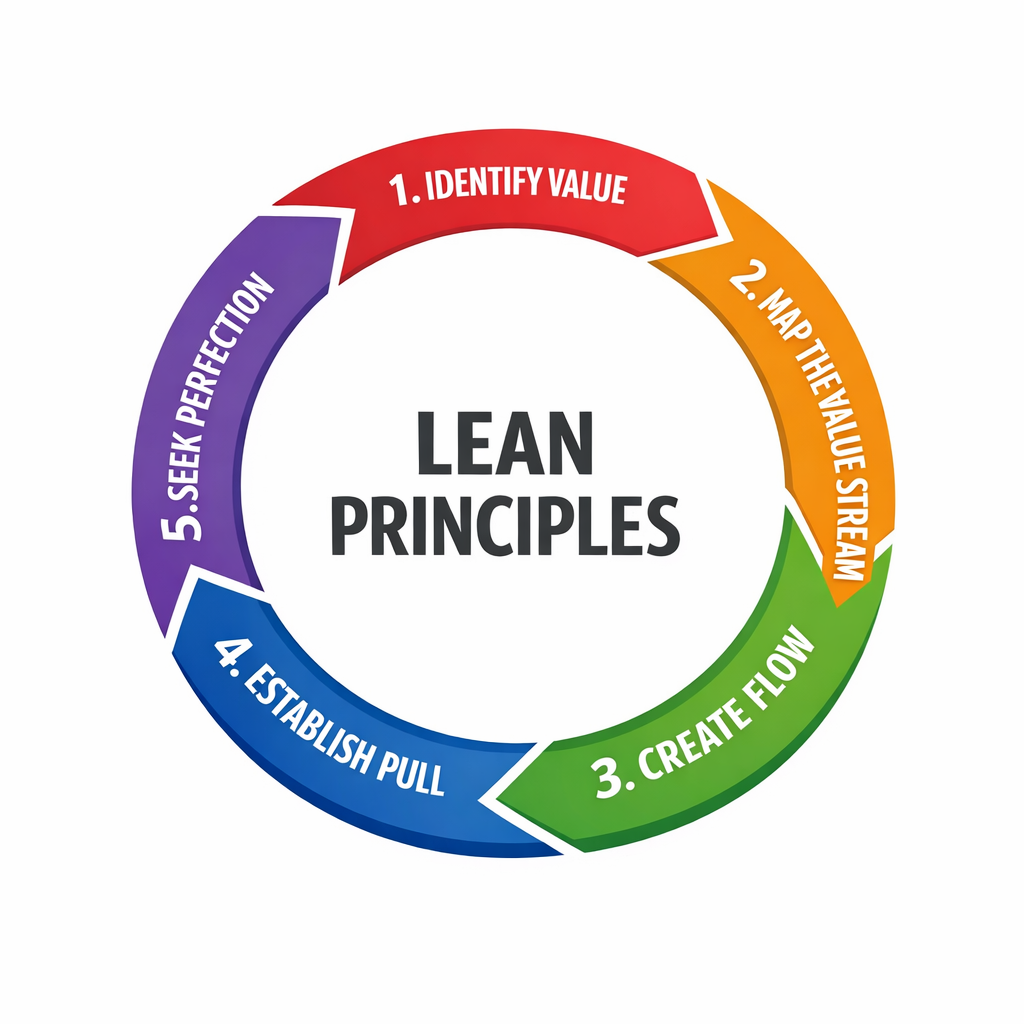
Lean trong software: tập trung vào customer-defined value, tối ưu flow end-to-end, giảm waste, cải tiến liên tục và tôn trọng con người.
TL;DR – Lean Software Development trong 1 phút
- Lean bắt nguồn từ Toyota Production System (TPS): tối ưu để giảm waste (lãng phí).
Đem qua software, Lean nhấn mạnh:
- Customer-defined value (giá trị do khách hàng định nghĩa)
- Flow (dòng chảy mượt – ít tắc nghẽn)
- Visual management (quản trị trực quan: board/flow/WIP)
- Continuous improvement + Respect for people (cải tiến liên tục & tôn trọng con người/trao quyền)
- Giao hàng theo lô nhỏ để nhận feedback sớm (small batches)
7 nguyên lý hay gặp (PMI-ACP keyword):
- Eliminate waste, Amplify learning, Defer commitment
- Deliver fast, Empower the team
- Build quality in (aka Build integrity in)
- Optimize the whole (aka See the whole)
Bẫy đề hay gặp:
- “Muốn nhanh thì hy sinh chất lượng” → ngược Lean (defects tạo rework + delay).
- “Tối ưu cục bộ” nhưng end-to-end vẫn tắc → ngược optimize/see the whole.
- “Làm thêm feature cho chắc” dù không ai dùng → waste.
- “Đẩy thêm việc để ai cũng bận” → WIP tăng, flow tệ (anti pull).
Gặp câu hỏi nói về waste, flow, WIP, visual management, continuous improvement, pull system, lead time/cycle time/throughput → nghĩ ngay đến Lean/Kanban.
1) Lean Software Development là gì?
Lean Software Development là cách áp dụng tư duy Lean vào phát triển phần mềm:
- Tập trung vào giá trị do khách hàng định nghĩa
- Tạo flow mượt (ít tắc nghẽn)
- Giao hàng nhanh để học nhanh (feedback sớm)
- Loại bỏ waste (mọi thứ không tạo giá trị)
Diễn giải:
- Nếu khách chỉ cần “đặt hàng + thanh toán”, nhưng team làm thêm “nhiều màn hình quản trị chưa có nhu cầu” → rủi ro cao là waste.
- Lean hỏi rất rõ: “Khách có dùng thật không? Có sẵn sàng trả tiền/đánh đổi cho phần đó không?”
2) Lean đến từ Toyota (TPS) – vì scale lớn, waste nhỏ cũng thành rất lớn
Lean (trong bối cảnh gốc) xuất phát từ Toyota Production System (TPS).
- Khi bạn sản xuất hàng triệu sản phẩm, chỉ cần lãng phí 2% thôi là thành chi phí cực lớn.
- Ví dụ: lãng phí 5% sơn cho 1 phòng có thể “chưa đáng kể”; nhưng nhân lên cho rất nhiều phòng thì thành “thất thoát hệ thống”.
Lean tập trung vào câu hỏi:
“Làm sao để giảm lãng phí và khuếch đại những yếu tố giúp giảm lãng phí?”
3) Lean core mà PMI đánh giá cao: Continuous improvement + Respect for people
Nhiều người nhớ Lean qua “waste/flow/tool”, nhưng PMI thường đánh giá cao tinh thần vận hành:
- Continuous improvement (Kaizen): cải tiến nhỏ, liên tục, dựa trên dữ liệu/feedback.
- Respect for people: tôn trọng người làm việc, tạo môi trường an toàn để nêu vấn đề, và trao quyền để quyết định đúng chỗ.
Nếu tình huống có xu hướng “quản lý kiểm soát quá chặt, mọi quyết định phải xin phép nhiều tầng, team khó cải tiến” → thường là ngược Lean/Agile.
Lean ưu tiên trao quyền, giảm “permission queue”, và cải tiến dựa trên feedback + dữ liệu.
3.1) Lean leadership: nhà quản lý nên làm gì để flow tốt hơn?
Trong bối cảnh Agile/Lean, vai trò quản lý không phải “đẩy việc” mà là gỡ tắc hệ thống:
- Giảm điểm nghẽn do phê duyệt: rõ ràng hóa policy, ủy quyền theo ngưỡng, hạn chế “chờ ký”.
- Tạo an toàn tâm lý: khuyến khích nêu vấn đề sớm (defect, rủi ro, bottleneck) thay vì “giấu cho xong”.
- Đầu tư chất lượng vào quy trình: automation (CI/CD, test), chuẩn hóa pipeline để giảm rework.
- Quan sát end-to-end: nhìn từ “request → delivered” (khách hàng thực sự nhận được) thay vì chỉ nhìn tốc độ của một bộ phận.
Một vòng Kaizen rất thực dụng:
- chọn 1 chỉ số (ví dụ lead time),
- thử 1 thay đổi nhỏ (ví dụ WIP limit),
- đo lại sau 1–2 tuần,
- giữ cái hiệu quả, bỏ cái không hiệu quả.
4) Đem Lean qua software: trực quan hóa flow, nhìn value, cải tiến liên tục
Khi đem Lean từ sản xuất sang phần mềm, “vật liệu” đổi thành:
- thời gian + sự tập trung của team
- chi phí sửa sai (rework)
- thời gian chờ (waiting)
- defect
- feature không ai dùng
Lean software thường dùng nhiều visual management:
- nhìn workflow rõ ràng (board)
- thấy bottleneck ở đâu
- giảm WIP (Work in Progress)
- tăng tốc feedback
5) 7 nguyên lý Lean Software Development (keyword rất hay lên đề)
Lưu ý thuật ngữ (dễ gặp trong tài liệu & đề thi): Build quality in ≈ Build integrity in • Optimize the whole ≈ See the whole (systems thinking).
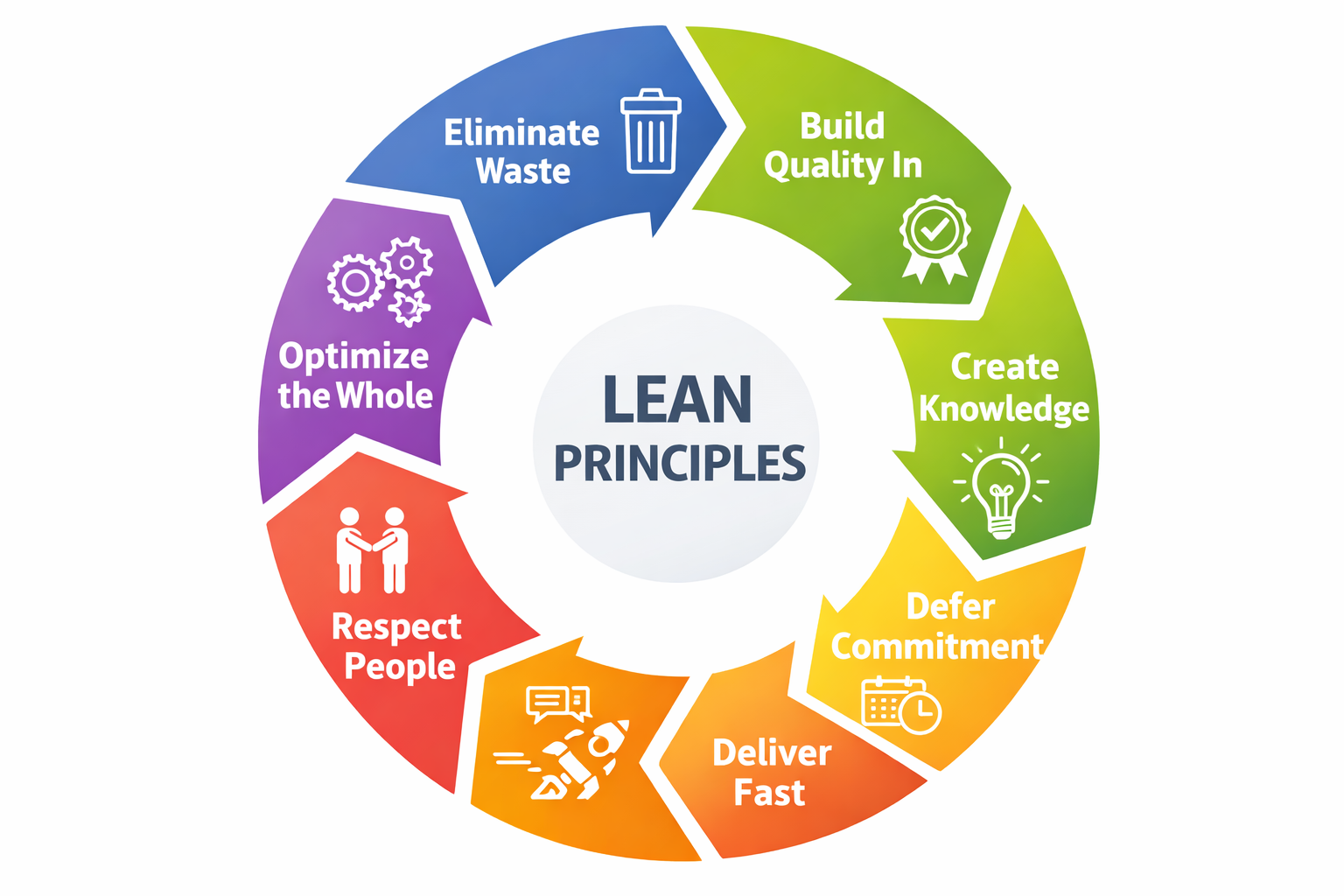
7 Lean principles (PMI-ACP keywords): eliminate waste, amplify learning, defer commitment, deliver fast, empower the team, build quality/integrity in, optimize/see the whole.
5.1 Eliminate waste – Loại bỏ lãng phí
Waste là bất cứ thứ gì không tạo giá trị cho khách hàng, làm chậm flow, hoặc tạo defect/rework.
5.2 Empower the team – Trao quyền cho team
Tránh micromanage. Người hiểu việc nhất thường là người đang làm việc đó. Trao quyền giúp quyết định nhanh hơn và giảm hàng đợi xin phép.
5.3 Deliver fast – Giao hàng nhanh
- Khách thấy giá trị sớm
- Team nhận feedback sớm
- Sai thì sửa sớm (thường rẻ hơn sửa muộn)
Lưu ý: deliver fast không đồng nghĩa “hy sinh chất lượng”. Lean ưu tiên small batches + feedback loop nhanh.
5.4 Optimize the whole – Tối ưu toàn hệ thống, không tối ưu cục bộ
Lean không thích “một khâu chạy nhanh” nhưng end-to-end vẫn tắc.
- Coding nhanh nhưng QA/Deploy tắc → lead time vẫn dài.
- Đẩy nhiều việc vào In Progress → WIP phình → waiting tăng → flow xấu đi.
5.5 Build quality in (Build integrity in) – Xây chất lượng ngay từ đầu
Chất lượng không phải “đợi cuối mới test”. Defect = waste. Lean nhấn mạnh quality là một phần của quy trình: kiểm tra sớm, automation, feedback sớm để giảm rework.
5.6 Defer commitment – Trì hoãn cam kết tới “thời điểm hợp lý nhất”
Defer commitment không có nghĩa là trì hoãn vô hạn.
Ý đúng: giữ lựa chọn mở và ra quyết định ở last responsible moment (khi đã có đủ thông tin để quyết tốt hơn).
- Trong software: làm spike/prototype nhỏ để học rồi mới chốt quyết định lớn (kiến trúc, vendor, cách triển khai).
5.7 Amplify learning – Khuếch đại học hỏi
Học hỏi là “nhiên liệu” để giảm waste: feedback sớm, thử nghiệm nhỏ, giao tiếp rõ, cải tiến liên tục.
6) Waste trong software: các “điểm ngốn thời gian” dễ bị bỏ qua
Dưới đây là waste “chuẩn bài thi” khi nói về Lean trong software (kèm ví dụ).
Gợi ý: “extra process/motion” thường là biểu hiện dẫn đến waiting, handoffs, task switching… (bận rộn nhưng ít Done).
- Partially done work (việc làm dở dang): làm 50% nhưng chưa ai dùng được → chưa tạo value.
- Delays / Waiting (chờ đợi): chờ duyệt, chờ môi trường, chờ review → lead time kéo dài.
- Handoffs (bàn giao): “đẩy qua team khác rồi chờ” → mất context, tăng lỗi, tăng thời gian.
- Extra features (tính năng không ai dùng): làm “cho đủ” nhưng không tạo value → waste.
- Task switching (đổi việc liên tục): đang làm A nhảy qua B → mất tập trung → tăng sai → kéo dài “làm dở”.
- Defects (lỗi): lỗi = sửa = rework = delay → waste “đậm đặc”.
- Relearning (học lại): đổi người/thiếu chia sẻ knowledge/đứt context → phải “học lại từ đầu” → chậm + dễ sai.
- Extra processes / Motion (quy trình thừa / hoạt động thừa): báo cáo, họp, ticket ping-pong quá mức… → tạo cảm giác bận, nhưng không tăng Done.
Trong Lean truyền thống, bạn có thể gặp bộ 3: Muda (waste/lãng phí), Mura (unevenness/dao động), Muri (overburden/quá tải).
Trong software, “waste” bên trên thường là Muda; WIP cao + task switching dễ tạo Mura; ép quá tải/không bền vững tạo Muri.
7) Lean/Kanban toolkit: đo flow bằng số liệu + Pull system (rất hay bị hỏi)
7.1 Lead time vs Cycle time (đo để biết đang tắc ở đâu)
- Lead time: từ lúc “được yêu cầu” (requested/committed) tới lúc “delivered”.
(Nôm na: khách đợi bao lâu để nhận được?) - Cycle time: từ lúc “bắt đầu làm” tới lúc “xong”.
(Nôm na: team mất bao lâu khi đã bắt tay vào làm?)
Gợi ý làm bài: Nếu đề nói “khách phàn nàn đợi lâu” → nghĩ lead time.
Nếu đề nói “một item lâu bất thường sau khi start” → nghĩ cycle time và bottleneck trong quy trình.
7.2 Throughput (tốc độ ra Done) + Little’s Law (phản xạ nhanh khi làm đề)
- Throughput: số item hoàn thành / đơn vị thời gian (ví dụ: 12 items/tuần).
- Little’s Law (cách dùng phổ biến trong Kanban/Lean):
Lead time ≈ WIP / Throughput
→ muốn lead time giảm: giảm WIP hoặc tăng throughput (ra Done đều).
Lưu ý: Công thức xấp xỉ hữu ích khi hệ thống tương đối ổn định (steady state). Trong đề thi, bạn dùng như “quy luật phản xạ” để chọn hành động ưu tiên: giảm WIP + xử bottleneck.
“Lead time đang quá dài, team nên làm gì trước?” → thường ưu tiên giảm WIP + xử bottleneck, hơn là “đẩy thêm việc để ai cũng bận”.
7.3 Cumulative Flow Diagram (CFD) & Control Chart (nhận diện bottleneck/độ ổn định)
- CFD: nhìn chỗ nào “phình” cột (In Progress/Testing…) → chỗ đó đang tắc.
- Control chart (cycle time scatter): xem cycle time có ổn định không, có outlier không, cải tiến có hiệu quả không.
7.4 Pull system + WIP limits (kéo việc theo năng lực, tránh “push”)
- Pull system: chỉ kéo thêm việc khi team còn capacity (không nhồi việc vào In Progress).
- WIP limits: giới hạn số việc đang làm để giảm task switching và giảm partially done work.
Ví dụ:
- “Push”: đẩy nhiều ticket vào In Progress → ai cũng bận → ít Done.
- “Pull”: In Progress giới hạn → team tập trung hoàn tất → Done đều, flow tốt hơn.
8) If you see → think → do (phản xạ làm bài thi)
| Nếu đề nói… | Nghĩ ngay… | Hành động Lean/Kanban “đúng hướng PMI” |
|---|---|---|
| “Ai cũng bận nhưng ít Done” | WIP cao, task switching, partially done work | Đặt WIP limits, swarm để finish, giảm batch |
| “Dev nhanh mà khách vẫn chờ lâu” | Lead time dài do bottleneck/queue | Visualize end-to-end flow, xử bottleneck (automation/pipeline), đo lead time |
| “Nhiều lỗi, rework liên tục” | Defects = waste | Build quality in: automation, shift-left, DoD rõ, ngừa lỗi sớm |
| “Quyết định kẹt vì chờ duyệt nhiều lớp” | Permission queue, anti-empower | Empower the team, policy rõ, giảm handoffs |
| “Yêu cầu/thiết kế hay đổi, chưa chắc hướng” | Uncertainty cao | Defer commitment, spike/prototype, quyết ở last responsible moment |
9) Áp dụng Lean trong dự án Agile: kết hợp với Scrum/Kanban (đời thực)
- Dùng Kanban board để trực quan hoá flow (visual management).
- Đặt WIP limits để giảm task switching và “làm dở”.
- Tập trung “finish work” (Done) thay vì “start work”.
- Dùng CI/CD + test automation để build quality/integrity in.
- Dùng Retro/Kaizen để continuous improvement.
- Đo lead time/cycle time/throughput để tìm bottleneck và kiểm chứng cải tiến.
- Lean thiên về principles/mindset: tối ưu value + flow bằng cách giảm waste.
- Kanban thiên về method để thực thi flow: visualize workflow, WIP limits, pull, policies, metrics.
- Trong đề thi: thấy “WIP limit/pull/board/CFD” → nghiêng Kanban; nhưng logic Lean (waste/flow/optimize whole) vẫn dẫn bạn tới đáp án đúng.
10) Exam patterns & traps – bẫy Lean trong PMI-ACP
- “Muốn nhanh thì bỏ bước test/QA” → ngược Lean (defects = waste, rework tăng).
- “Tối ưu một nhóm thật nhanh” nhưng lead time vẫn dài vì chỗ khác tắc → ngược optimize/see the whole.
- “Càng nhiều feature càng tốt” → ngược Lean (extra features = waste).
- “Quản lý phải quyết hết để kiểm soát” → ngược empower the team + respect for people.
- “Defer commitment = không quyết gì cả” → sai. Lean là quyết ở thời điểm hợp lý nhất (last responsible moment).
- “Đẩy thêm việc để mọi người bận rộn” → WIP phình, lead time tăng (anti pull).
11) Mini scenarios (đúng kiểu đề PMI-ACP): nhận diện waste → hành động Lean
Scenario 1: “Bận rộn nhưng không ra Done”
Team có nhiều ticket đang “In Progress”. Ai cũng bận, nhưng Sprint Review gần tới vẫn ít cái Done.
Mọi người liên tục đổi task vì “cái nào cũng gấp”.
- Waste chính: Task switching + Partially done work.
- Hành động Lean tốt nhất: đặt WIP limits, swarm để finish, chuyển từ “start work” sang “finish work”.
- KPI theo dõi: cycle time giảm, throughput/Done tăng đều.
Scenario 2: “Khách chờ quá lâu dù dev code rất nhanh”
Dev báo “code xong trong 1–2 ngày”, nhưng khách phải đợi 2–3 tuần mới nhận được.
QA/Deploy hay bị kẹt vì thiếu môi trường và quy trình release phức tạp.
- Vấn đề: bottleneck ở QA/Deploy + Waiting → vi phạm Optimize the whole.
- Hành động Lean tốt nhất: trực quan hoá flow end-to-end, xử bottleneck (automation, chuẩn hoá pipeline), giảm batch size.
- Đo đúng: Lead time mới phản ánh “khách đợi bao lâu”.
Scenario 3: “Yêu cầu thay đổi liên tục, stakeholder muốn chốt kiến trúc ngay”
Stakeholder muốn “chốt kiến trúc & vendor ngay hôm nay” để “đỡ đổi”. Nhưng yêu cầu còn mơ hồ và thay đổi mỗi tuần.
Team lo quyết sớm sẽ lock-in sai và trả giá rework.
- Lean principle: Defer commitment (decide at last responsible moment).
- Hành động đúng kiểu PMI: làm spike/prototype nhỏ để học, giữ lựa chọn mở (set-based thinking), chốt khi có dữ liệu/learning đủ.
- Anti-pattern: chốt sớm để “yên tâm”, rồi rework lớn khi requirement đổi.
12) Principle → Intent → Exam keywords (bảng nhồi nhanh)
| Lean principle | Intent (ý nghĩa) | Exam keywords hay gặp |
|---|---|---|
| Eliminate waste | Bỏ thứ không tạo value | waste, non-value-added, reduce rework |
| Deliver fast | Feedback sớm, lead time ngắn | small batches, fast feedback, shorten lead time |
| Build quality in / Build integrity in | Ngừa lỗi sớm | defect prevention, automation, built-in quality |
| Optimize the whole / See the whole | Tránh tối ưu cục bộ | system thinking, end-to-end flow, bottleneck |
| Empower the team | Quyết nhanh, đúng chỗ | self-managing, decentralized decision-making |
| Defer commitment | Giữ lựa chọn mở | last responsible moment, late binding decisions, spike |
| Amplify learning | Học nhanh để giảm waste | feedback loops, experimentation, continuous improvement |
13) Checklist học nhanh
Checklist – Lean Software Development (VI)
Mini-mock – Lean Software Development
- Lean = tối ưu value + flow bằng cách giảm waste (đồng thời tôn trọng con người và trao quyền).
Keywords: customer-defined value, visual management, continuous improvement, respect for people, eliminate waste, build quality/integrity in, optimize/see the whole, deliver fast, empower the team, defer commitment, amplify learning, pull system, WIP, lead time/cycle time/throughput, Little’s Law, CFD/control chart.
- Đề hay gài: tối ưu cục bộ, làm thêm feature, hy sinh quality, quản lý quyết hết, hiểu sai “defer commitment”, push việc làm WIP phình.
Lean Software Development – Toyota Lean applied to software (clear and practical)
Lean has a very direct rule: if customers don’t value it, building it is likely waste.
Lean Software Development brings Toyota-style waste reduction into software delivery.
Lean in software: customer-defined value, end-to-end flow, waste reduction, continuous improvement, and respect for people.
TL;DR – Lean Software Development in 1 minute
- Lean comes from the Toyota Production System (TPS): optimize to reduce waste.
In software, Lean emphasizes:
- Customer-defined value
- Flow (smooth end-to-end delivery)
- Visual management (boards, flow, WIP)
- Continuous improvement + Respect for people (empowerment, psychological safety)
- Small batches to learn fast (feedback loops)
The 7 principles you’ll see in exams:
- Eliminate waste, Amplify learning, Defer commitment
- Deliver fast, Empower the team
- Build quality in (aka Build integrity in)
- Optimize the whole (aka See the whole)
Common PMI-ACP traps:
- “Go faster by skipping quality” → anti-Lean (defects create rework and delays).
- “Optimize one area” while the system is still blocked → violates optimize/see the whole.
- “Add features just in case” → waste.
- “Push more work so everyone is busy” → higher WIP, worse flow (anti pull).
If a scenario talks about waste, flow, WIP, visual management, continuous improvement, pull system, or lead time / cycle time / throughput → think Lean / Kanban.
1) What is Lean Software Development?
- Focus on customer-defined value
- Create smooth flow (less blockage)
- Deliver fast to learn fast (feedback loops)
- Eliminate waste (anything that doesn’t create value)
Everyday translation:
- If users only need “order + pay”, building “many admin screens without clear demand” is likely waste.
- Lean asks: “Will customers value it and actually use it?”
2) Lean comes from Toyota (TPS) – small waste becomes massive at scale
Lean originated from the Toyota Production System (TPS).
- If you build millions of products, even 2% waste becomes huge money.
- Waste that looks small at the micro level becomes systemic at scale.
Lean’s core question: “How do we reduce waste and amplify what removes waste?”
3) PMI-friendly Lean core: Continuous improvement + Respect for people
People often remember Lean as “waste/flow/tools”, but PMI also rewards the human and system side:
- Continuous improvement (Kaizen): small frequent improvements driven by feedback/data.
- Respect for people: empower those closest to the work, create psychological safety, reduce “permission queues”.
If the scenario suggests “manager approves everything / heavy micromanagement / too many approvals” → it’s usually anti-Lean/anti-Agile.
Lean prefers empowerment, explicit policies, and improvement based on feedback + data.
3.1) Lean leadership: what should managers do?
In Lean/Agile environments, leaders improve flow by removing systemic blockers:
- Reduce approval bottlenecks (clear thresholds, delegation, explicit policies).
- Create psychological safety so issues surface early (defects, risks, bottlenecks).
- Invest in built-in quality (automation, CI/CD, stable environments) to reduce rework.
- Measure end-to-end outcomes (request → delivered), not just local speed.
A practical Kaizen loop:
- pick one metric (e.g., lead time),
- run a small change (e.g., a WIP limit),
- measure again after 1–2 weeks,
- keep what works, drop what doesn’t.
4) Lean in software: visual tools, value focus, continuous improvement
When Lean moves into software, the “materials” become:
- team time and focus
- rework cost
- waiting time
- defects
- features nobody uses
Lean software teams use visual management heavily:
- make workflow visible
- spot bottlenecks
- limit WIP
- speed up feedback
5) The 7 Lean Software Development principles
Terminology note (common in sources and exams): Build quality in ≈ Build integrity in • Optimize the whole ≈ See the whole (systems thinking).
7 Lean principles (PMI-ACP keywords): eliminate waste, amplify learning, defer commitment, deliver fast, empower the team, build quality/integrity in, optimize/see the whole.
5.1 Eliminate waste
Waste is anything that doesn’t create customer value, slows flow, or generates defects/rework.
5.2 Empower the team
Don’t micromanage. People closest to the work often know the best next move. Empowerment removes “permission queues”.
5.3 Deliver fast
Customers see value sooner, feedback arrives sooner, and fixing mistakes early is cheaper than late.
PMI nuance: delivering fast doesn’t mean sacrificing quality. Lean prefers small batches with fast feedback.
5.4 Optimize the whole (See the whole)
Lean hates local optimization.
- Making coding faster doesn’t help if testing/deploy is the bottleneck.
- Starting more work (high WIP) often increases waiting and lead time.
5.5 Build quality in (Build integrity in)
Quality is not an afterthought. Defects are waste. Build quality into the process via early checks, automation, and feedback loops.
5.6 Defer commitment
Defer commitment is not procrastination. It means keeping options open and deciding at the
last responsible moment when you have better information.
Often: learn through small experiments (spikes/prototypes) before locking a big decision.
5.7 Amplify learning
Learning reduces waste. Amplify learning through early feedback, experiments, clear communication, and continuous improvement.
6) Waste in software: invisible time-burners
These are common Lean software wastes you’ll see in PMI-style scenarios.
Tip: “extra process/motion” is often a symptom that creates waiting, handoffs, and context switching (busy, not Done).
- Partially done work: half-built features no one can use yet → no value.
- Delays / Waiting: waiting for approvals, environments, reviews → longer lead time.
- Handoffs: passing work across teams → lost context, more errors, more waiting.
- Extra features: features nobody uses → pure waste.
- Task switching: jumping between tasks → loss of focus → more defects and unfinished work.
- Defects: defects → rework → delays → loss of trust.
- Relearning: knowledge loss / context breaks → re-learn from scratch → slower and riskier.
- Extra processes / Motion: excessive reporting/meetings/ticket ping-pong → activity without increased Done.
In classic Lean you may see: Muda (waste), Mura (unevenness), Muri (overburden).
In software: many wastes above are Muda; high WIP/context switching often creates Mura; forced overload creates Muri.
7) Lean/Kanban toolkit: flow metrics + pull system (often tested)
7.1 Lead time vs Cycle time
- Lead time: from request/commitment to delivery (how long customers wait).
- Cycle time: from start to done (how long it takes once work begins).
Exam hint: “Customer waits too long” → lead time.
“Work takes too long after starting” → cycle time + a workflow bottleneck.
7.2 Throughput + Little’s Law
- Throughput: completed items per unit time (e.g., 12 items/week).
- Little’s Law (common Lean/Kanban use):
Lead time ≈ WIP / Throughput
→ shorten lead time by lowering WIP and/or increasing throughput (steady Done).
Note: This approximation is most useful when the system is relatively stable (steady state). In exam scenarios, treat it as a practical rule: reduce WIP and fix bottlenecks first.
“Lead time is too long — what’s the best next step?” → often reduce WIP + fix bottlenecks, not “push more work so everyone is busy.”
7.3 CFD & Control charts
- Cumulative Flow Diagram (CFD): see where queues build up (a column “bulges”) → bottleneck.
- Control chart (cycle time scatter): check stability, spot outliers, validate improvement.
7.4 Pull system + WIP limits
- Pull: pull new work only when there’s capacity (don’t push into In Progress).
- WIP limits: cap work-in-progress to reduce context switching and unfinished work.
8) If you see → think → do (exam reflex)
| If the scenario says… | Think… | PMI-friendly Lean/Kanban move |
|---|---|---|
| “Everyone is busy, little Done” | High WIP, task switching, unfinished work | Set WIP limits, swarm to finish, reduce batch size |
| “Dev is fast, customers wait weeks” | Long lead time due to bottleneck/queues | Visualize end-to-end flow, fix bottleneck (automation/pipeline), measure lead time |
| “Too many defects & rework” | Defects = waste | Build quality in: automation, shift-left, clear DoD |
| “Decisions stuck in approvals” | Permission queue, anti-empowerment | Empower the team, clarify policies, reduce handoffs |
| “High uncertainty, asked to lock decisions now” | Risk of wrong early commitment | Defer commitment, spikes/prototypes, decide at last responsible moment |
9) Applying Lean in Agile projects: combine with Scrum/Kanban (real life)
- Use a Kanban board to visualize flow.
- Set WIP limits to reduce task switching and unfinished work.
- Focus on finishing (Done) rather than starting.
- Use CI/test automation to build quality/integrity in.
- Use retros/Kaizen for continuous improvement.
- Measure lead time/cycle time/throughput to locate bottlenecks and validate improvements.
- Lean is often a principles/mindset: optimize value + flow by eliminating waste.
- Kanban is often a method: visualize workflow, WIP limits, pull, explicit policies, metrics.
- In PMI-ACP scenarios: “WIP/pull/board/CFD” points to Kanban; Lean logic still guides the best action.
10) Exam patterns & traps – Lean in PMI-ACP
- “Skip QA/testing to go faster” → anti-Lean (defects = waste, rework increases).
- “Optimize team A only” while the bottleneck is elsewhere → violates optimize/see the whole.
- “More features is always better” → extra features are waste.
- “Managers must decide everything” → conflicts with empower the team + respect for people.
- “Defer commitment means never deciding” → wrong. Lean decides at the right time with better information.
- “Push more work to keep everyone busy” → increases WIP and worsens flow (anti pull).
11) Mini scenarios (PMI-style): identify waste → choose a Lean action
Scenario 1: “Busy, but little Done”
The team has many tickets in “In Progress”. Everyone is busy, but Done items are few.
People keep switching because “everything is urgent”.
- Main waste: Task switching + Partially done work.
- Best Lean move: set WIP limits, swarm to finish, shift from “start work” to “finish work”.
- Metric: cycle time down, throughput/Done up.
Scenario 2: “Dev is fast, customers still wait weeks”
Dev says “coding is done in 1–2 days”, but customers wait weeks.
QA/deploy is blocked by environments and a complex release process.
- Problem: bottleneck in QA/deploy + Waiting → violates Optimize the whole.
- Best Lean move: visualize end-to-end flow, fix bottleneck (automation/pipeline), reduce batch size.
- Measure: Lead time reflects customer waiting time.
Scenario 3: “Requirements change weekly, asked to lock architecture now”
A stakeholder wants to “lock architecture and vendor today”.
But requirements are unclear and keep changing. The team fears wrong lock-in and massive rework.
- Lean principle: Defer commitment (decide at the last responsible moment).
- PMI-friendly move: run small spikes/prototypes to learn, keep options open (set-based thinking), decide with evidence.
- Anti-pattern: lock early “for certainty”, then pay huge rework when reality changes.
12) Principle → Intent → Exam keywords (quick cram table)
| Lean principle | Intent | Common exam keywords |
|---|---|---|
| Eliminate waste | Remove non-value work | waste, non-value-added, reduce rework |
| Deliver fast | Shorten lead time | small batches, fast feedback, shorten lead time |
| Build quality in / Build integrity in | Prevent defects early | defect prevention, automation, built-in quality |
| Optimize the whole / See the whole | End-to-end flow | system thinking, bottleneck, end-to-end |
| Empower the team | Faster, better decisions | self-managing, decentralized decisions |
| Defer commitment | Keep options open | last responsible moment, late binding, spike |
| Amplify learning | Learn fast to reduce waste | feedback loops, experimentation, continuous improvement |
13) Checklist & self-reflection
Checklist – Lean Software Development (EN)
Mini-mock – Lean Software Development
- Lean = optimize value + flow by eliminating waste (with respect for people and empowerment).
Keywords: customer-defined value, visual management, continuous improvement, respect for people, eliminate waste, build quality/integrity in, optimize/see the whole, deliver fast, empower the team, defer commitment, amplify learning, pull system, WIP, lead time/cycle time/throughput, Little’s Law, CFD/control charts.
- PMI-ACP traps: local optimization, extra features, skipping quality, manager-only decisions, misunderstanding “defer commitment”, pushing work (high WIP).